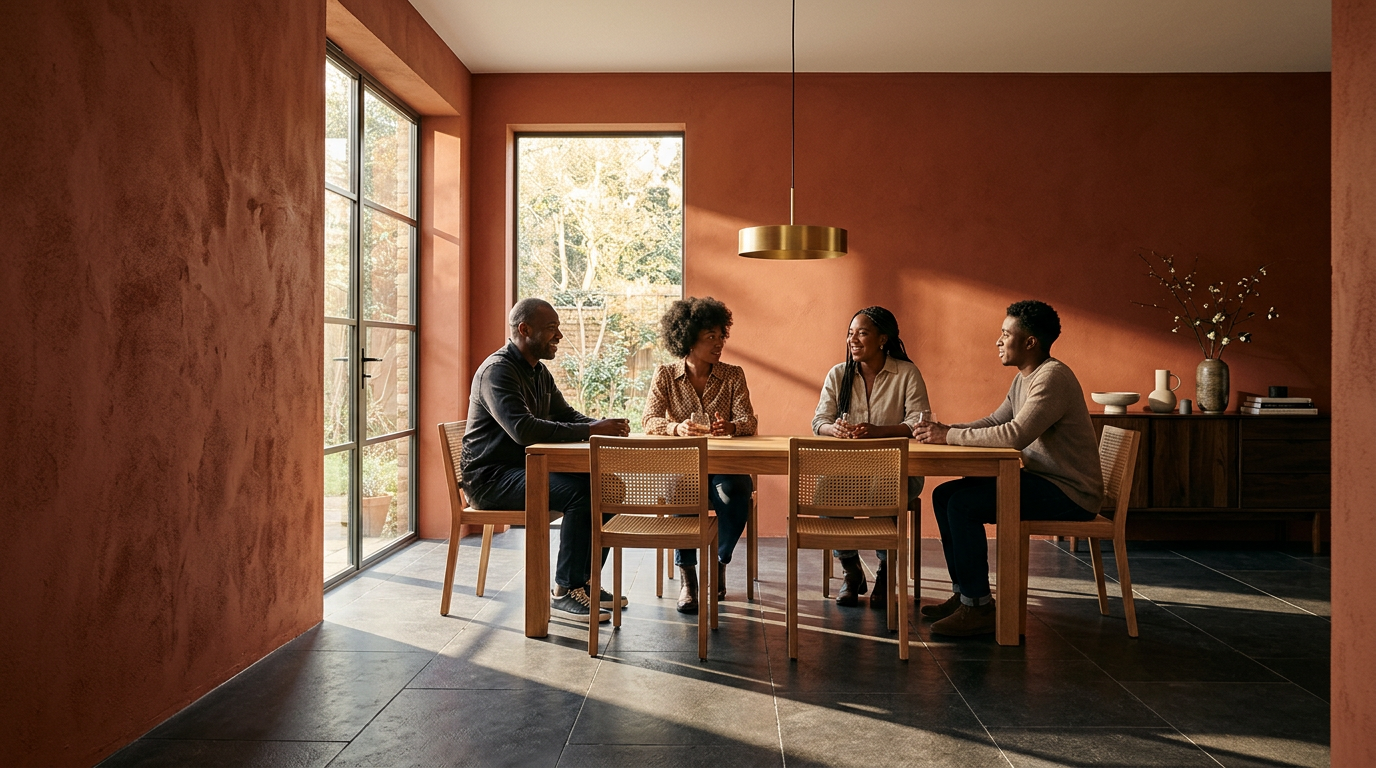
In the contemporary discourse of residential design, there exists a pervasive obsession with the neutral palette. We are often told that white walls and pale oak floors provide a blank canvas for living, yet this approach frequently ignores the profound emotional impact of color when applied with architectural intent. The recent renovation of a historic urban residence challenges this paradigm by treating pigment not as a decorative afterthought, but as a primary structural material that defines the volume and emotional temperature of the home.
The project serves as a compelling argument for the use of saturated color to articulate spatial transitions. Rather than relying on physical barriers or changes in floor material to demarcate zones, the design team utilized deep, matte pigments to create what one might call chromatic thresholds. In the primary living chamber, walls bathed in a rich, muted terracotta absorb the harsh glare of direct light, softening the edges of the room and imbuing the space with a sense of grounded permanence. This is not merely a coat of paint. It is a deliberate manipulation of the way light behaves within a confined volume, turning the air itself into a palpable, colored atmosphere.
Color as a spatial anchor is a concept that requires immense restraint and a sophisticated understanding of light physics. By selecting hues that respond dynamically to the sun throughout the diurnal cycle, the designers have ensured that the house remains in a constant state of flux. At high noon, the walls appear crisp and sculptural, emphasizing the sharp angles of the built-ins. As the sun moves toward the horizon, the surfaces deepen, effectively compressing the space and creating an intimate, cocoon-like environment. This rhythmic shift allows the architecture to mirror the psychological needs of its inhabitants, moving from a space of cognitive clarity to one of restorative quietude.
Central to this success is the interplay between these saturated surfaces and the secondary materials. The floors, finished in a honed charcoal limestone, provide a cool, dark anchor that prevents the warmer wall colors from feeling overwhelming. This contrast is essential. Without the grounding influence of the stone, the chromatic density of the walls would feel chaotic rather than curated. The choice of hardware is equally deliberate. Brushed brass fittings appear to float against the deep pigments, catching light like small, glowing artifacts. These metallic accents serve as the punctuation marks of the design, providing a tactile transition between the expansive wall surfaces and the functional elements of the home.
The craft of building is fundamentally an act of orchestration. In this renovation, the architects demonstrated that when every element, from the finish of a door handle to the specific light-reflective value of a pigment, is considered in relation to the whole, the result is more than just a renovation. It becomes a site of cultural inquiry. The residents no longer occupy a series of rooms, but rather a sequence of experiences defined by depth, shadow, and color. This approach proves that modern luxury is not found in the acquisition of expensive, ephemeral trends. Instead, it is found in the rigorous pursuit of atmosphere.
For those looking to achieve a similar resonance, the takeaway is clear: avoid the urge to lighten every corner. Embrace the potential of shadow and saturation. When we allow a wall to hold color, we allow it to hold presence. We invite the architecture to participate in the daily life of the inhabitant rather than standing as a passive background. By stripping away the unnecessary ornamentation and focusing on the purity of color-based volumes, the designers have created a home that feels both ancient and entirely contemporary. It is a reminder that the most significant architectural interventions are those that refine our perception of the space we inhabit, turning the domestic realm into a gallery of light and pigment.