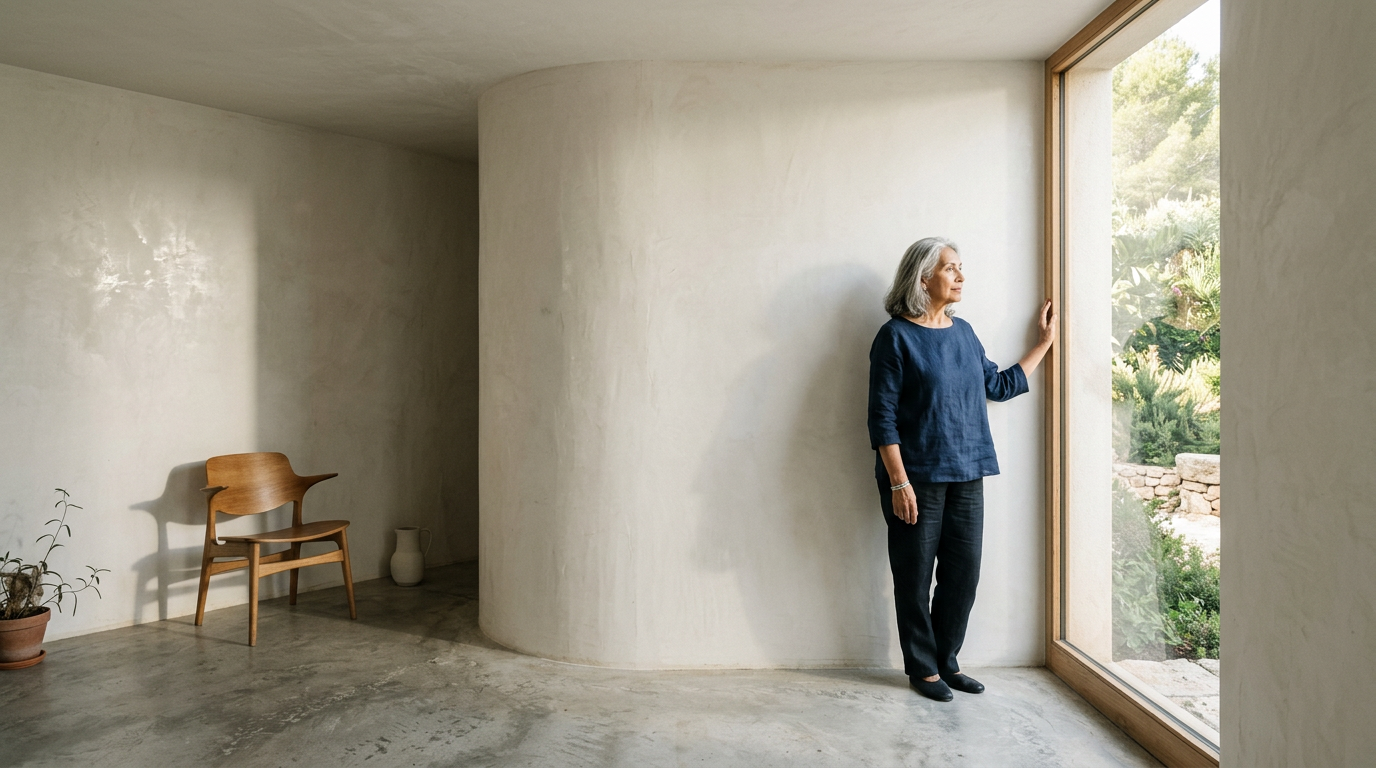
Architecture often finds its most profound expression not in the complexity of its joinery or the audacity of its cantilever, but in the quiet, absolute continuity of its skin. In a recent residential intervention, the design team chose to strip away the vernacular clutter of a mid-century structure to reveal something far more elemental. By applying a monochromatic, hand-troweled lime plaster across every vertical and horizontal plane, the architects achieved a rare sense of sculptural gravity. The residence no longer functions as a collection of partitioned chambers, but rather as a singular, carved object where light behaves with a different set of physical laws.
The choice of material here is critical. Lime plaster is a living finish that possesses a depth of field rarely found in synthetic paints. Because it is applied in thin, overlapping layers by human hands, the surface captures the subtle imperfections of the craft. When the morning sun moves across these walls, the light does not simply bounce off a flat surface. Instead, it catches the microscopic undulations of the trowel marks, creating a soft, diffuse glow that seems to emanate from within the structure itself. This is the antithesis of the clinical, high-gloss finish often favored in modern minimalist design. It is a finish that invites touch and ages with a dignified patina, rewarding the inhabitant with a tactile experience that evolves throughout the day.
Spatial relationships are fundamentally altered when baseboards, window casings, and crown moldings are systematically excised. In this renovation, the threshold between wall and floor is handled with a seamless radius, a subtle curve that eliminates the harsh shadow lines typically found at floor junctions. By removing these traditional architectural punctuation marks, the eye is forced to process the room as a volume of air rather than a series of flat surfaces. This creates a psychological effect of expansion. The architecture recedes so the inhabitant may occupy the space more fully. There is a distinct lack of friction in the transition from one area to the next, which lends the entire floor plan a sense of fluid, uninterrupted movement.
The dialogue between the monolithic interior and the external landscape is perhaps the most striking aspect of the project. Because the plaster walls act as a neutral, light-absorbing canvas, the green hues of the surrounding garden are reflected into the interior with startling clarity. The windows are no longer framed as pictures on a wall; they are simply apertures cut into a solid mass. This creates a contemplative environment where the focus remains tethered to the natural world outside. The interior serves as a gallery for shadow and chlorophyll, grounding the inhabitants in a rhythm that feels ancient and inevitable.
To achieve this level of interior cohesion, one must embrace the discipline of subtraction. Every outlet, switch, and HVAC vent was meticulously integrated into the plasterwork or hidden behind custom-milled panels that disappear into the wall plane. Design excellence is often found in what is omitted. By hiding the mechanical necessities of contemporary life, the architect allows the purity of the form to remain the primary focus. This approach requires a high degree of coordination between the masonry team and the electrical engineers, but the result is a home that feels curated rather than constructed.
Ultimately, this renovation serves as a reminder that the most sophisticated homes are those that prioritize the visceral experience of space. By returning to the basic tenets of mass, light, and texture, the designers have created a sanctuary that resists the fleeting nature of domestic trends. It is a project that understands that a home is not merely a machine for living, but a vessel for the human spirit. In the quietude of these plaster-clad rooms, there is a profound sense of stillness, a testament to the idea that architecture is at its best when it provides a backdrop for the complexities of daily life without competing for attention. It is a masterclass in the power of the singular material to elevate the everyday into the extraordinary.