Architecture has long sought to reconcile the tension between the ephemeral nature of human dwelling and the permanence of the landscape. While many contemporary structures attempt to impose themselves upon a site with sharp geometries or shimmering facades, there exists a more profound approach that treats the house as a physical extension of the terrain. Rammed earth, an ancient construction technique revived for the modern era, represents the ultimate synthesis of geology and domesticity. By compressing local aggregates into dense, structural walls, architects are creating interiors that do not merely inhabit the land but emerge from it with a sense of inevitability.
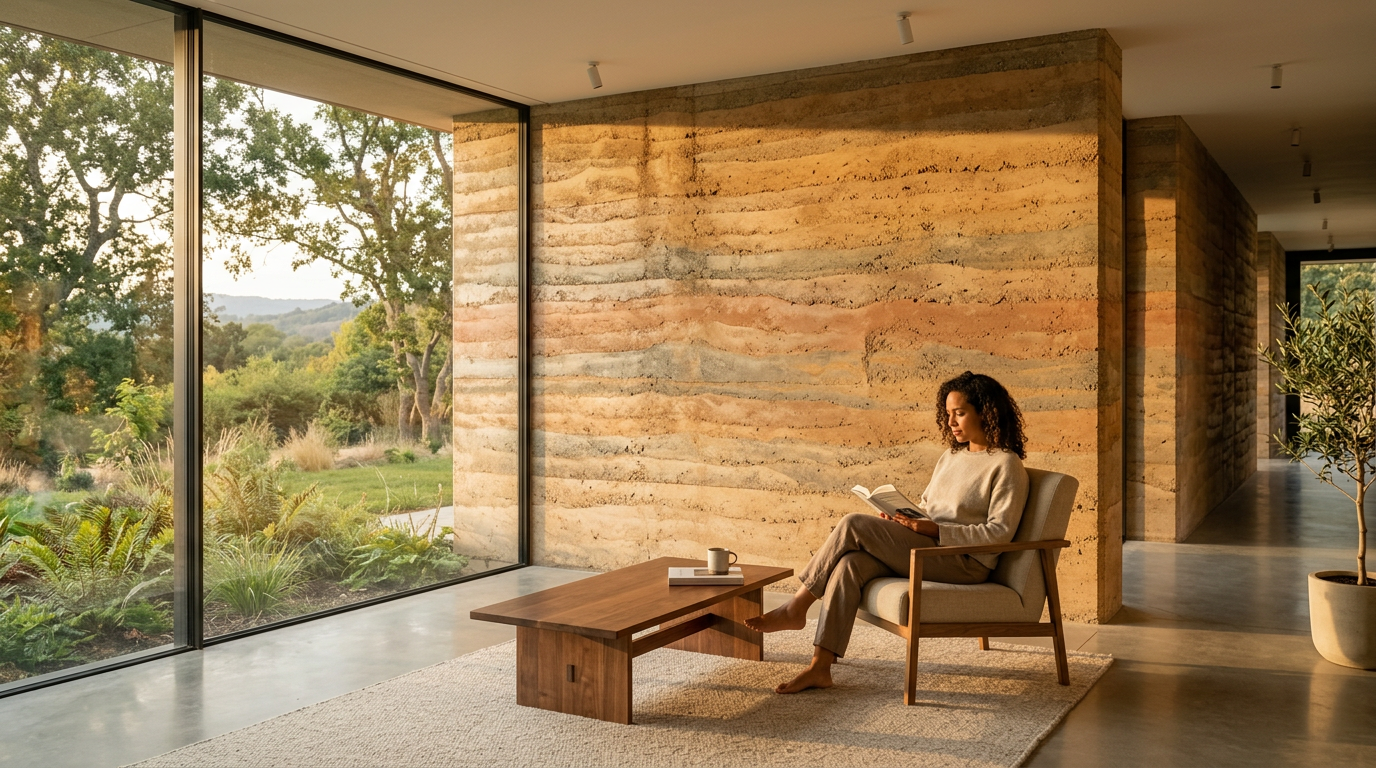
The craft of rammed earth is a process of deliberate sedimentation. It begins with the extraction of earth from the site itself or its immediate vicinity, a practice that anchors the building in the specific mineral composition of the region. Workers blend clay, sand, silt, and a minimal stabilizing agent before compacting the mixture into formwork in successive layers. This creates a rhythmic stratification, a horizontal banding that serves as a chronological record of the wall’s creation. These layers are not merely aesthetic choices: they are the physical manifestation of the building process, capturing the pressure of the rammer and the variability of the soil. The resulting surfaces possess a profound geological honesty that renders decorative finishes entirely redundant.
Beyond its visual gravity, rammed earth offers a sophisticated performance in thermal regulation. The material is characterized by high thermal mass, which allows the home to absorb heat during the periods of peak solar exposure and release it slowly as temperatures drop. This natural cycle of thermal inertia creates a stable indoor climate that feels inherently balanced and calm. Unlike synthetic insulation, which often creates a hermetic, sterile environment, the porous nature of rammed earth walls allows for a subtle, natural respiration. Residents often describe the atmosphere within these spaces as resonant, characterized by a quiet acoustic dampening that softens the harsh edges of modern life.
The spatial relationship between a rammed earth structure and its surroundings is one of quiet transition. Because the walls carry the color and texture of the local subsoil, they form a seamless dialogue with the exterior landscape. When a rammed earth wall extends from the interior of a living room out into a garden, the distinction between inside and outside blurs. The building becomes a frame through which the site is viewed, yet the house itself remains a continuation of that very site. This blurring of boundaries is the hallmark of truly significant residential design, as it invites the occupant to exist in a state of constant connection with the earth.
There is also an undeniable tactile quality to these surfaces that defies the industrial precision of standard construction. A rammed earth wall is not perfectly flat or uniform. It bears the slight imperfections of the hand and the tool, a subtle topography that invites the touch of the inhabitant. In an era increasingly dominated by smooth, synthetic surfaces, this material provides a sensory anchor. It demands that we acknowledge the substance of our shelter. The wall becomes a living record, weathering and shifting in appearance as the light tracks across its surface throughout the day, catching the mica or quartz inclusions embedded within the matrix.
The longevity of this material is perhaps its most compelling argument. While many modern building systems rely on components with a limited lifespan, a well-engineered rammed earth wall is built for centuries of service. It is a form of durable architecture that respects the resources consumed in its creation by choosing to endure rather than iterate. Architects who choose this medium are embracing a philosophy of stewardship. They recognize that the most significant homes are those that honor the site from which they were drawn, providing a sanctuary that is as steady, grounded, and timeless as the ground beneath our feet.