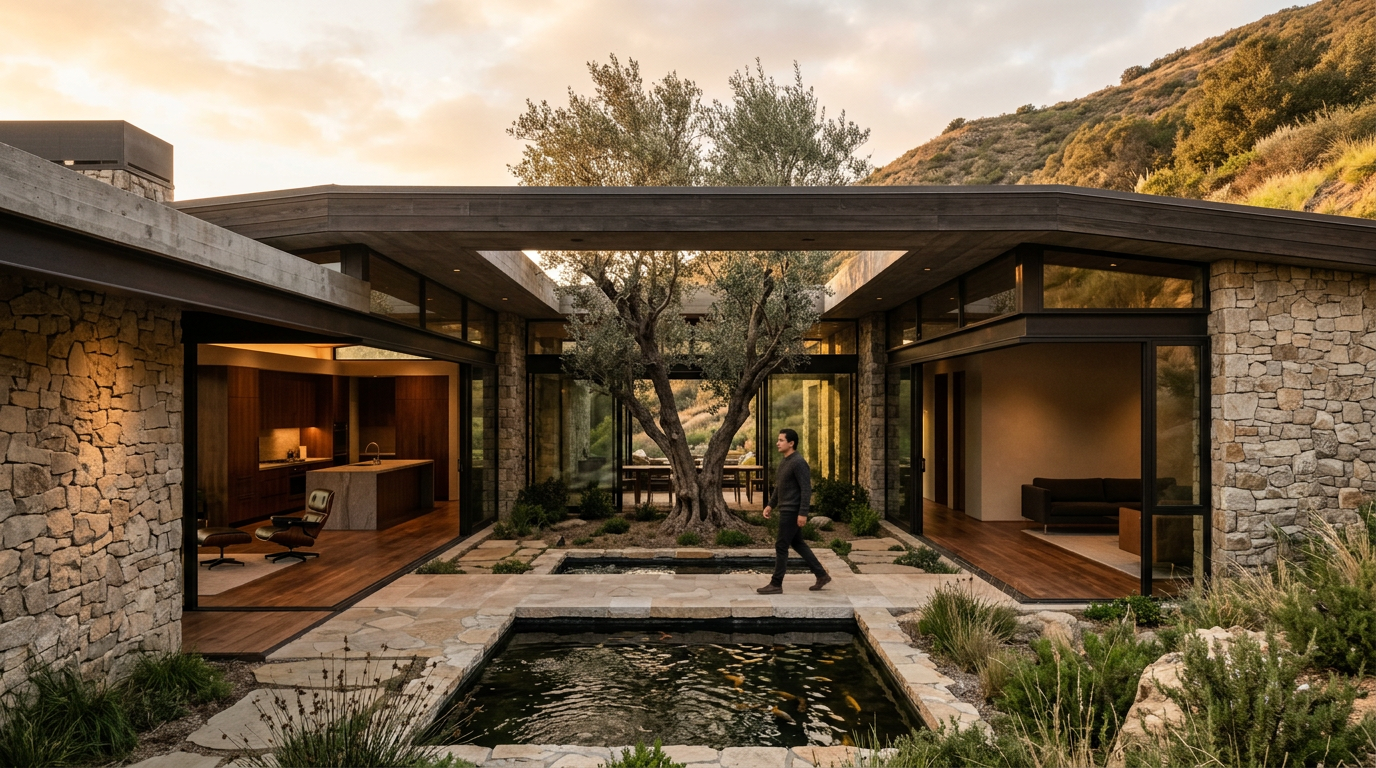
In the contemporary discourse on high-end residential design, the primary objective has too often become the total domination of the site. Architects frequently treat the plot of land as a tabula rasa, a blank canvas upon which to project a rigid ego. However, the most profound examples of domestic architecture reject this adversarial stance. Instead, they embrace the concept of environmental symbiosis, where the structure acts as a sophisticated membrane that mediates between the internal human experience and the external biological reality. This approach requires a radical shift in perspective, moving away from the idea of the home as a hermetically sealed box and toward the idea of the home as a living extension of its geography.
The hallmark of such a design philosophy is the strategic implementation of the void. When we discuss the void, we are not speaking of empty space in the sense of absence or lack of utility. Rather, we are discussing the deliberate carving out of the building mass to invite the local ecosystem into the heart of the dwelling. This is achieved through the integration of internal courtyards, subterranean ventilation chambers, and cantilevered roof planes that allow for the migration of air and flora through the dwelling. By allowing the landscape to penetrate the footprint of the home, the boundary between the built environment and the organic world becomes intentionally porous. The residence ceases to be an object placed upon the earth and becomes a site-specific intervention that actively participates in the cycles of the day and the season.
Materiality plays a decisive role in this dialogue. To achieve true symbiosis, the choice of materials must be dictated by the immediate context rather than global trends. When a structure utilizes stone excavated directly from the site for its foundations, or timber sourced from the surrounding forest for its structural frame, the building acquires a chromatic and tonal harmony with its surroundings. This is not merely an aesthetic preference. It is an exercise in ecological honesty. When materials are allowed to weather, oxidize, and patina in reaction to the specific humidity, salinity, and UV exposure of the region, the building enters into a state of graceful transition. The building is no longer a static monument but a dynamic participant in the natural process of decay and renewal.
The orientation of these structures is equally critical to their success. Rather than relying on mechanical systems to regulate the interior climate, the architect must look to the ancient wisdom of passive solar design, reinterpreted through a modern lens. The placement of overhangs, the depth of window reveals, and the use of thermal mass are all tools that allow a house to breathe with the environment. By calculating the path of the sun with mathematical precision, one can ensure that the home absorbs warmth during the cooler months while remaining shielded from the intensity of the midday sun in the heat of summer. This creates an interior climate that feels fundamentally natural, a steady state that is maintained not by energy-intensive hardware but by the intelligent calibration of the building envelope.
Ultimately, the goal of this architectural practice is to cultivate a heightened sense of human belonging. When a home is designed to mirror the rhythms of the earth, the inhabitants experience a subtle but profound realignment. They become attuned to the passing of clouds, the shifting shadows of the canopy, and the seasonal changes in the quality of the air. This is the antidote to the disconnection that characterizes modern suburban life. A residence that prioritizes environmental symbiosis provides a sanctuary that is both protective and expansive, grounding the occupant in the reality of their place on the planet. By relinquishing the desire to control the environment and choosing instead to frame and celebrate it, we create architecture that possesses a timeless, enduring relevance. We transform the house into an artifact that honors the land upon which it sits, ensuring that the legacy of the design is one of mutual respect between human inhabitant and the natural world.