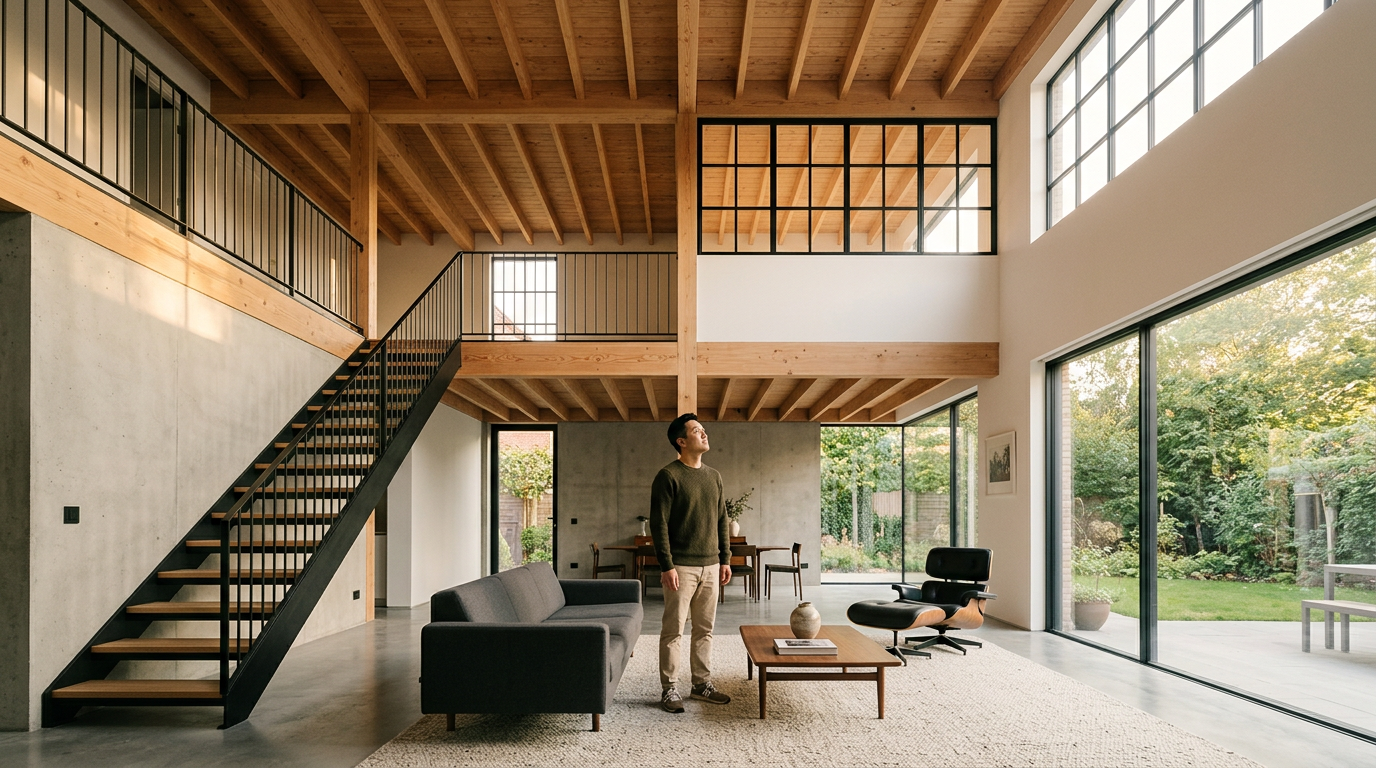
In the lexicon of residential architecture, the horizontal axis is often prioritized for its capacity to ground us within a landscape. We speak frequently of the seamless flow between indoors and out, or the expansive reach of a terrace toward the horizon. Yet, there exists a more elusive, perhaps more spiritually resonant dimension of domestic space: the vertical volume. When a dwelling rejects the constraints of the standard ceiling plane in favor of a soaring, double-height expanse, it ceases to be merely a place of habitation and becomes a cathedral of daily life. This is not about the ostentation of scale, but rather the intentional manipulation of air, shadow, and the human sense of proportion.
The vertical void acts as a vital lung for the home. By introducing a significant height differential within the floor plan, the architect initiates a distinct thermal and acoustic dialogue. In these cavernous spaces, air does not simply move; it circulates with a rhythmic, predictable grace, rising to meet the clerestory windows that often crown such designs. The result is a sensory experience that feels inherently atmospheric. One does not merely walk through such a room. One occupies the space between the floor and the rafters, feeling the gentle shift in pressure and the amplification of the slightest sound. It is a reminder that architecture is not just the arrangement of solid walls, but the deliberate sculpting of the invisible.
Light, too, behaves with newfound complexity when tasked with filling a vertical shaft. In a standard room, illumination is often a matter of lateral utility. In a double-height volume, light becomes a kinetic protagonist. As the sun traverses the sky, the depth of the space allows for a gradual, nuanced descent of brilliance. Morning light may strike the upper reaches of a gallery wall, casting long, dramatic shadows across the lower living areas. By midday, the space is flooded with a diffuse, atmospheric glow that softens the sharp edges of furniture and cabinetry. This changing quality of light serves as a gentle clock, tethering the inhabitants to the solar cycle in a way that ground-level windows rarely achieve.
The structural challenge of the vertical void demands a rigorous material discipline. To support such grand proportions, one must look toward the honest expression of the frame. Whether it is a grid of exposed steel, a series of laminated timber beams, or the sheer, gravity-defying weight of board-formed concrete, the vertical structure serves as the primary visual anchor. It is here that the architect reveals the skeleton of the home. When we look up, we are not looking at a ceiling, but at the very mechanics of shelter. The intersection of a stairwell with these vertical volumes further enhances the experience, allowing residents to view their own movement from multiple vantage points. As one ascends a staircase that hugs the perimeter of a double-height wall, the perspective shifts constantly, transforming the simple act of moving between floors into a choreographed performance.
There is a necessary humility in living beneath such immense volume. It reminds us that our domestic lives are small, yet capable of harboring great intention. By carving out a void, we provide space for the imagination to expand. It is an architectural gesture that encourages us to look up, to acknowledge the zenith, and to find beauty in the sheer capacity of a room to hold more than just furniture. The vertical void is the ultimate luxury, not because it is expensive to build, but because it is rare to feel so completely released from the claustrophobia of the everyday. In these homes, the ceiling is not a limit, but a starting point for a conversation between the interior environment and the vastness of the sky above.