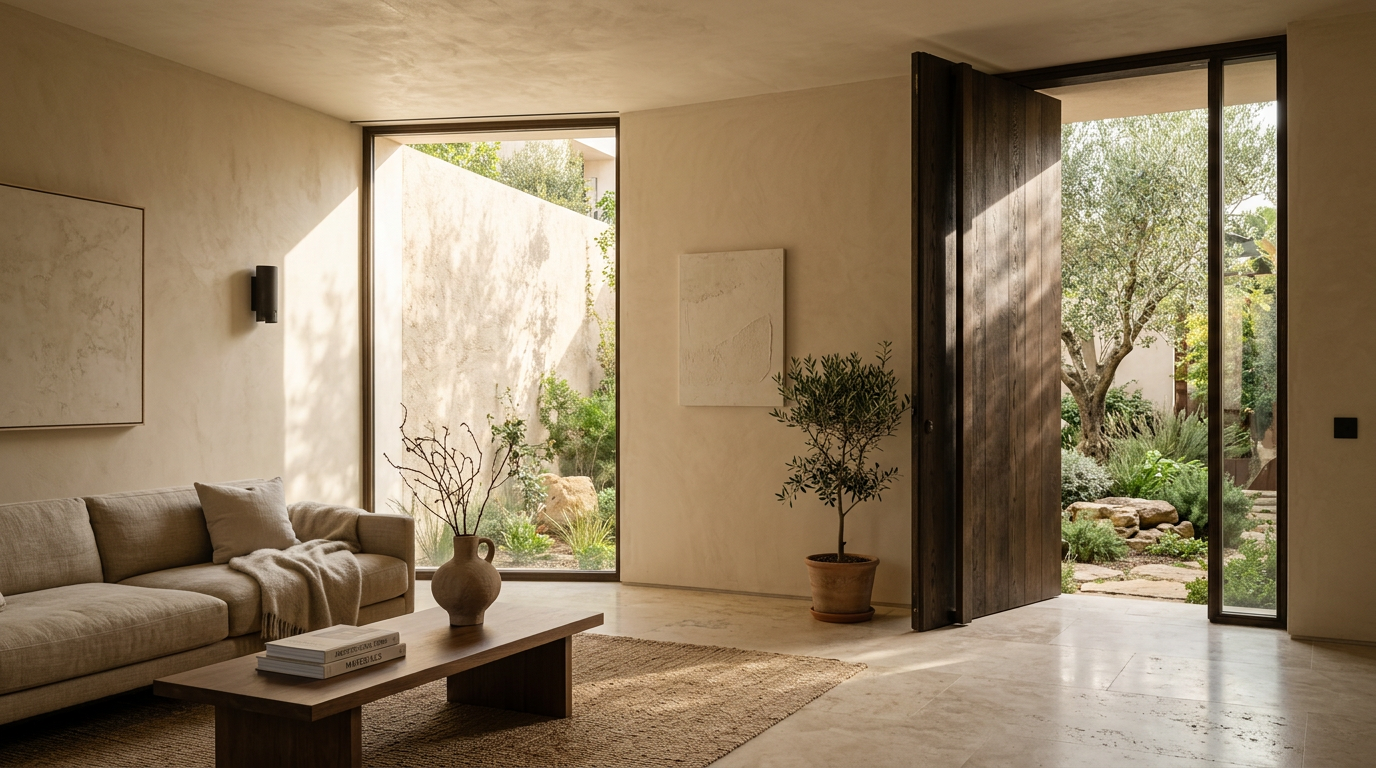
The evolution of the domestic interior has often been a struggle between the ephemeral and the permanent. In the mid-twentieth century, the architectural industry pivoted toward speed: drywall and latex paint became the standard for their ease of application and immediate, albeit superficial, perfection. However, contemporary architecture is witnessing a profound return to the mineral surface. Lime plaster, a medium that predates the Roman Empire, is being re-evaluated not as a nostalgic relic, but as a sophisticated tool for managing light, moisture, and spatial continuity.
To understand the architectural significance of lime is to understand the chemistry of the living wall. Unlike the synthetic films created by acrylic paints, which sit atop a substrate like a plastic glove, lime plaster is vapor-permeable. It allows the structure to breathe, drawing moisture from the air and releasing it as humidity levels drop. This hygroscopic nature makes it a functional participant in the home’s climate control. When applied to masonry or specialized lath, the plaster undergoes a carbonation process: it absorbs carbon dioxide from the atmosphere and reverts to its original state of limestone. The wall does not merely dry: it petrifies, becoming a monolithic extension of the building’s structural logic.
The aesthetic power of mineral finishes lies in their unique relationship with light. Synthetic paints are often designed for flat uniformity, absorbing or reflecting light in a predictable, two-dimensional manner. In contrast, lime-based finishes such as Marmorino or Tadelakt are composed of microscopic calcite crystals. When light hits these surfaces, it is not simply reflected: it penetrates the upper layers of the plaster and bounces back from within the material. This creates a soft, internal glow that shifts throughout the day. In a room finished in hand-burnished lime, the transition from highlight to shadow is never harsh: it is a gradual, velvet-like gradient that softens the sharpest of modernist angles.
The craft of application is where the material transcends the industrial. A lime-plastered wall is a record of human movement. Every stroke of the trowel, every pressure point applied by the artisan, contributes to a subtle topography of texture. In the case of Tadelakt, a traditional Moroccan technique, the plaster is compressed with a river stone and treated with olive oil soap. This chemical reaction creates a hydrophobic surface that is both waterproof and seamless. For the architect, this offers the rare opportunity to eliminate grout lines entirely: the walls, floors, and even the bathtub can be rendered as a single, continuous sculptural volume.
This spatial continuity is perhaps the most compelling argument for the mineral finish in modern design. In a minimalist program, the goal is often the reduction of visual noise. By wrapping corners, niches, and ceiling transitions in a consistent mineral skin, the architect can blur the boundaries of a room. The eye no longer stops at the junction of wall and ceiling: instead, it follows a fluid path, perceiving the space as a carved void rather than an assembled box. This sense of weight and permanence provides a psychological grounding that thin-wall construction often lacks.
Furthermore, mineral finishes possess a haptic quality that demands interaction. There is a coolness to the touch, a stone-like density that suggests a building intended to last for centuries. As the material ages, it does not peel or flake: it develops a patina. It heals itself through its own crystalline structure, becoming more resilient over time. In an era of disposable finishes, the choice of lime plaster is a commitment to the long arc of architectural history. It is a material that rewards the patient observer, offering a depth of color and a richness of texture that only becomes more pronounced as the sun moves across the sky.
Ultimately, the case for mineral finishes is a case for the sensory experience of the home. It is a rejection of the sanitized and the mass-produced in favor of a surface that is alive. By prioritizing the craft of the plasterer and the inherent beauty of the stone, architects are creating environments that are not just seen, but felt. These are spaces that resonate with the silence of the earth, providing a serene backdrop for the complexities of modern life.