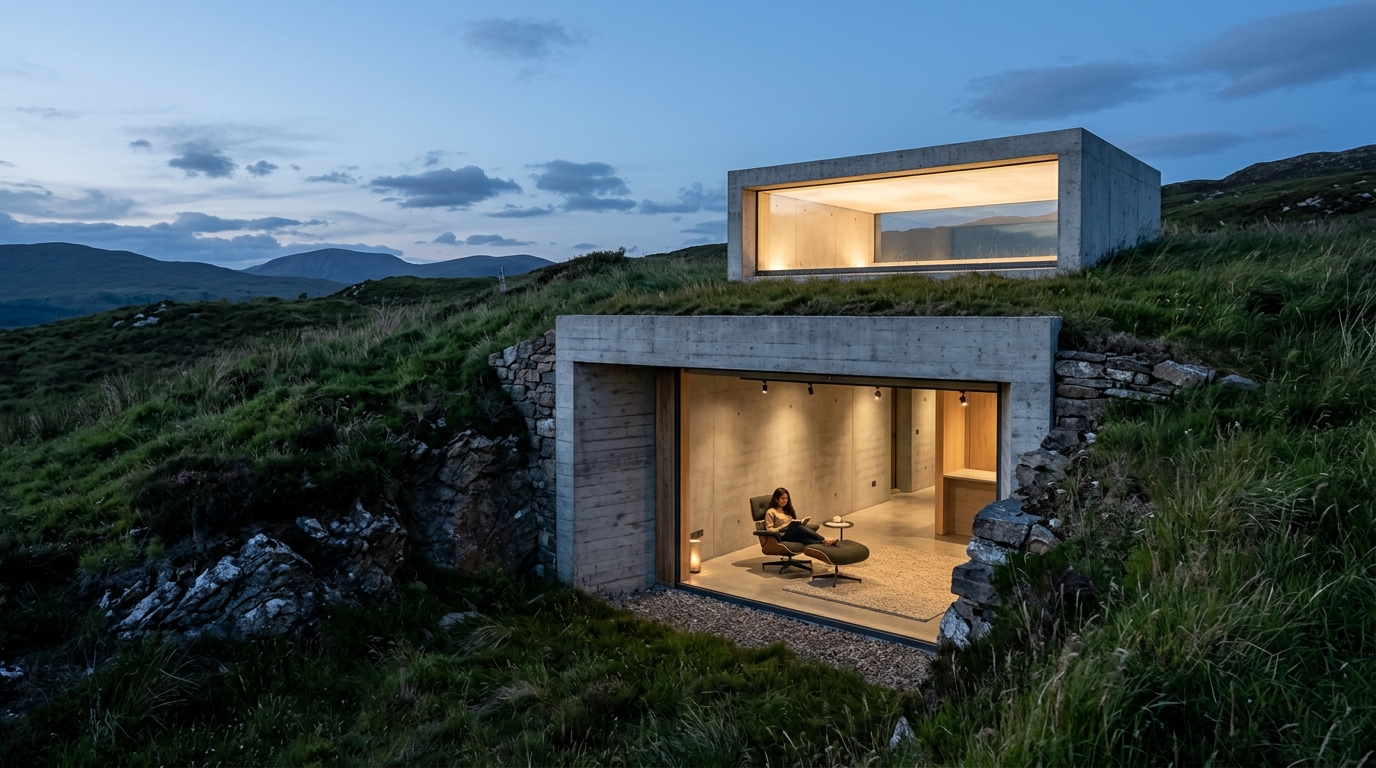
In the traditional lexicon of residential construction, the act of building is almost exclusively understood as additive. We aggregate timber, stack masonry, and weld steel until a form emerges from the flat plane of the lot. Yet, there is a quieter, more profound methodology currently reclaiming its place in the architectural canon: subtractive architecture. This approach treats the site not as a blank canvas, but as a solid block of potentiality. By carving into the topography, architects are discovering that the most compelling domestic spaces are those that exist within the earth rather than merely upon it. The shift from building 'on' to building 'in' represents a fundamental reimagining of the home as a geological fixture.
Subtractive architecture demands a rigorous understanding of the site’s subterranean conditions. It is a process of revelation. When a residence is excavated into a hillside, the earth itself becomes the primary structural envelope. This provides an immediate and peerless solution to the problem of thermal inertia. While a glass-walled pavilion must fight the elements with complex mechanical systems, the subterranean home utilizes the constant temperature of the soil to maintain a stable interior climate. This is not merely a functional advantage: it is a sensorial one. There is a specific, hushed quality to the air in an excavated room, a density that provides a psychological sense of sanctuary that a lightweight frame can never replicate.
The primary challenge of the carved home is the introduction of light. Without the benefit of traditional four-wall fenestration, the architect must look upward. The oculus and the lightwell become the lifeblood of the subtractive home, transforming the ceiling into a dynamic canvas of celestial movement. By slicing precise apertures through the roof plane, light is channeled deep into the floor plan, often reflecting off raw concrete or stone walls to create a soft, diffused glow. These lightwells do more than illuminate: they act as structural lungs, providing natural ventilation and a vertical connection to the sky that anchors the inhabitant to the passing of the day. The result is a home that feels both grounded and ethereal, a space that acknowledges the weight of the world above while celebrating the clarity of the light from within.
Materiality in subtractive architecture often leans toward the monolithic. Board-formed concrete is a frequent choice, as its textured surface can be articulated to mimic the sedimentary layers of the earth it replaces. When the interior walls share the same material language as the retaining structures, the boundary between the natural and the man-made begins to dissolve. Architects are increasingly using stone and concrete not as decorative cladding, but as the literal bones of the site, ensuring that the house feels less like an imposition and more like an inevitable outcome of the landscape. This material honesty is crucial: if the home is to be carved, the surfaces must speak of the effort of that carving, showing the grain, the aggregate, and the marks of the tools used to create the void.
Furthermore, the subtractive approach offers a unique solution to the problem of density and privacy in sensitive landscapes. By burying the bulk of a home’s square footage, an architect can preserve the visual integrity of a ridgeline or a coastal bluff. The house disappears from the horizon, leaving only a subtle intervention on the surface: perhaps a low stone wall or a series of skylights flush with the meadow. This humility is the ultimate luxury. It allows for a vast, expansive interior that does not compromise the natural beauty of the surroundings. The dialogue between the structure and the landscape is no longer one of competition, but of total integration.
Ultimately, the case for subtractive architecture is a case for permanence. In an era of disposable materials and fleeting trends, the excavated home stands as a cultural artifact that is built to endure for centuries. It rejects the fragility of the modern envelope in favor of the enduring strength of the earth. To live in a carved space is to experience architecture at its most elemental: as a shelter that provides a profound sense of belonging to the very ground beneath our feet. As we continue to seek ways to live more harmoniously with our environment, the lesson of the void becomes clear: sometimes the most significant thing an architect can do is know what to take away.