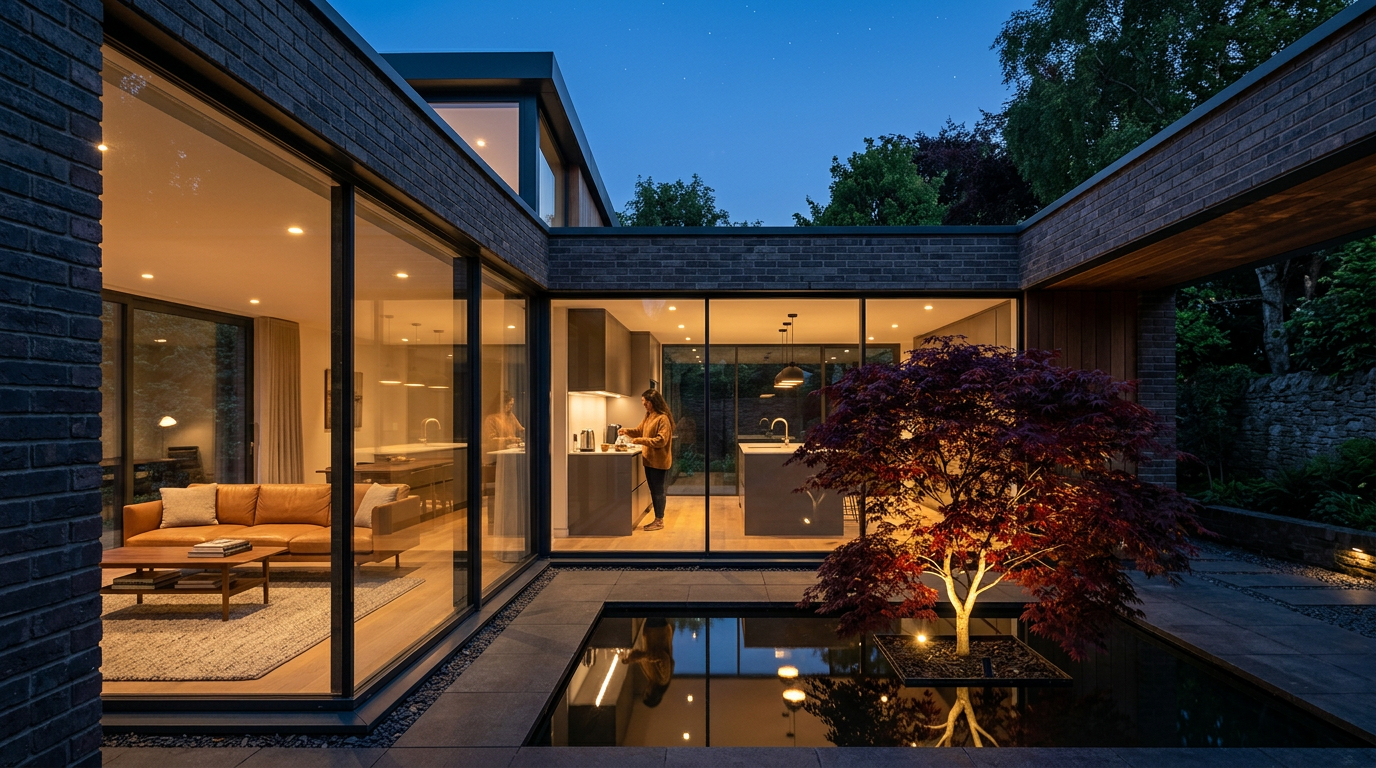
The contemporary residence often finds itself in a state of conflict with its surroundings. As urban density increases and the traditional buffer of the suburban lawn becomes an unsustainable relic, architects are returning to a typology that prioritizes the internal over the external. This is the architecture of the inward house: a design philosophy that centers the living experience around a protected, open-air core. Unlike the outward-facing villa that seeks to dominate its site, the courtyard house retreats, creating a private universe where the sky is the primary view and the boundary between nature and shelter is blurred without sacrificing security.
Historically, the courtyard has served as the heartbeat of domestic life across civilizations, from the Roman atrium to the Chinese siheyuan. In a modern context, the courtyard functions as a programmatic lung. It is the vital organ through which the house breathes, circulates air, and gathers light. In the context of the inward house, the floor plan is often organized as a series of interconnected volumes that wrap around this central void. This arrangement allows for a unique degree of visual transparency: from the kitchen, one might look across a bed of moss and weathered stone to see the flickering of a fireplace in the primary suite. This visual connection fosters a sense of unity within the household, even when physical separation is maintained for privacy.
The choice of materials in these inward-facing structures is critical to their success as sanctuaries. Because the exterior walls are often monolithic and relatively opaque to block out the noise of the street, the interior surfaces facing the courtyard must do the heavy lifting of defining the home’s character. Architects often employ high-performance glazing and slender steel mullions to minimize the distinction between the conditioned space and the garden. When the walls are composed of tactile materials like hand-molded brick, charred timber, or raw concrete, they serve as a canvas for the shifting patterns of light that filter down into the central void. The courtyard becomes a clock, marking the passage of the day through the movement of shadows across a textured surface.
Beyond its aesthetic and psychological contributions, the courtyard is a sophisticated tool for environmental stewardship. In arid climates, the central garden acts as a thermal buffer, cooling the air before it enters the living spaces. Through the use of water features or dense plantings, the courtyard creates a microclimate that can significantly reduce the reliance on mechanical cooling. This is the essence of passive architectural performance: using the geometry of the building itself to regulate comfort. The chimney effect created by the central opening allows warm air to rise and escape, drawing cooler air through the shaded perimeters of the home. This logic of ventilation is timeless, yet it feels increasingly relevant as we seek ways to build more responsibly.
The psychological impact of the inward house cannot be overstated. In an era of constant digital connectivity and urban sensory overload, the ability to retreat into a space that is entirely controlled and serene is a profound luxury. The courtyard offers a curated encounter with nature: a single tree, the sound of rain hitting a stone basin, or the sight of the moon framed by the roofline. This is not the wild, unpredictable nature of the forest, but a domesticated landscape that serves as an extension of the interior architecture. It provides a sense of enclosure and safety while simultaneously offering the infinite expansiveness of the sky above.
Designing an inward house requires a courageous rejection of the public-facing facade as a status symbol. It demands that the architect and the inhabitant prioritize the quality of the internal experience over the performance of the house for the street. When the focus shifts inward, the home ceases to be a mere object on a plot of land and becomes an immersive environment. It is a sanctuary of spatial clarity and environmental intelligence, proving that the most powerful architectural statements are often those that are hidden from view, tucked away behind a humble wall, centered around a quiet and luminous void.