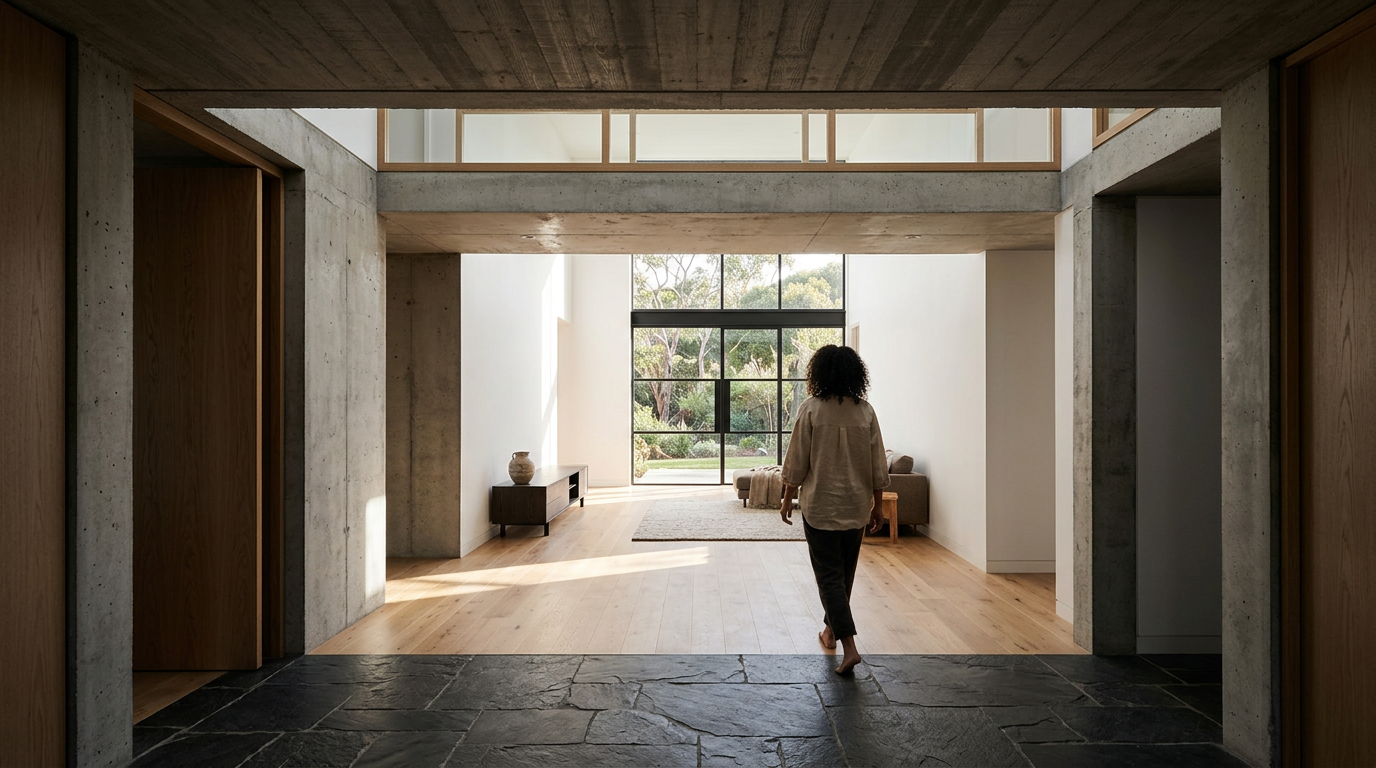
In the lexicon of residential design, we often fixate on the destination, the grand living room or the master suite, while neglecting the journey. We treat the act of crossing from the exterior world into the private sanctuary as a mere necessity of circulation. However, the most compelling homes treat the threshold not as a line on a floor plan, but as a deliberate architectural interval. This is the liminal space where the inhabitant sheds the weight of the outside environment and prepares to engage with the domestic interior. To master the transition is to curate the psychological state of the occupant.
Consider the power of the compressed entry. Architects who understand the nuance of spatial sequencing often employ a lower ceiling height at the point of arrival, which serves to ground the body and slow the pace. When this tight, intimate zone gives way to a soaring, light-filled volume, the effect is physically palpable. It is a orchestrated release of tension, a spatial exhale that reinforces the distinction between the public sphere and the private retreat. The successful threshold acts as a decompression chamber for the soul. By modulating the scale and the illumination, the designer dictates the transition from the frantic energy of the street to the deliberate stillness of home life.
Materiality plays a vital role in this sensory shift. A change in flooring texture, from the raw, conductive grit of exterior slate to the warm, forgiving grain of rift-sawn white oak, signals to the body that the environment has changed. It is a tactile prompt that alters our gait and our posture. When we design these spaces, we must consider the friction between materials. A transition strip should not be a visual apology, but a seamless intersection of purpose. The choice of hardware, the depth of a door jamb, and the way light catches the texture of a wall surface all contribute to the narrative of arrival.
Lighting, too, must be treated with surgical precision in the entry sequence. Rather than flooding the zone with uniform, aggressive illumination, the designer should prioritize shadows and focal points. A single, focused pendant or a wash of light grazing a textured masonry wall provides a sense of enclosure. Light should be used to draw the eye toward the interior, creating a magnetic pull that invites exploration. By keeping the immediate entry soft and shadowed, the brighter, more expansive rooms beyond gain a sense of promise. The home becomes a series of unfolding revelations rather than a static box to be consumed in a single glance.
We must also address the dialogue between the threshold and the landscape. A well-designed entry sequence acknowledges the climate and the topography. In coastal dwellings, the entry might be framed by wind-battered cedar, providing a transition from the chaotic, salt-heavy atmosphere of the coast to an interior defined by calm, climate-controlled silence. In urban environments, the threshold serves as a necessary barrier against the visual noise of the city, utilizing deep reveals and heavy, sound-attenuating apertures to define a boundary that is as much acoustic as it is physical.
Ultimately, a house that succeeds at the threshold is one that respects the human need for ritual. We are creatures of habit who crave markers in our daily lives. When we design for the transition, we are not merely arranging floor space, we are crafting the architecture of return. We are building the moment where the inhabitant arrives at their own identity, leaving behind the roles they play in the outside world to inhabit the space they have curated for themselves. This is the highest form of architectural care: the recognition that the way we enter a space defines how we occupy it. The threshold is the heartbeat of the home, the point where the architecture finally begins to breathe.