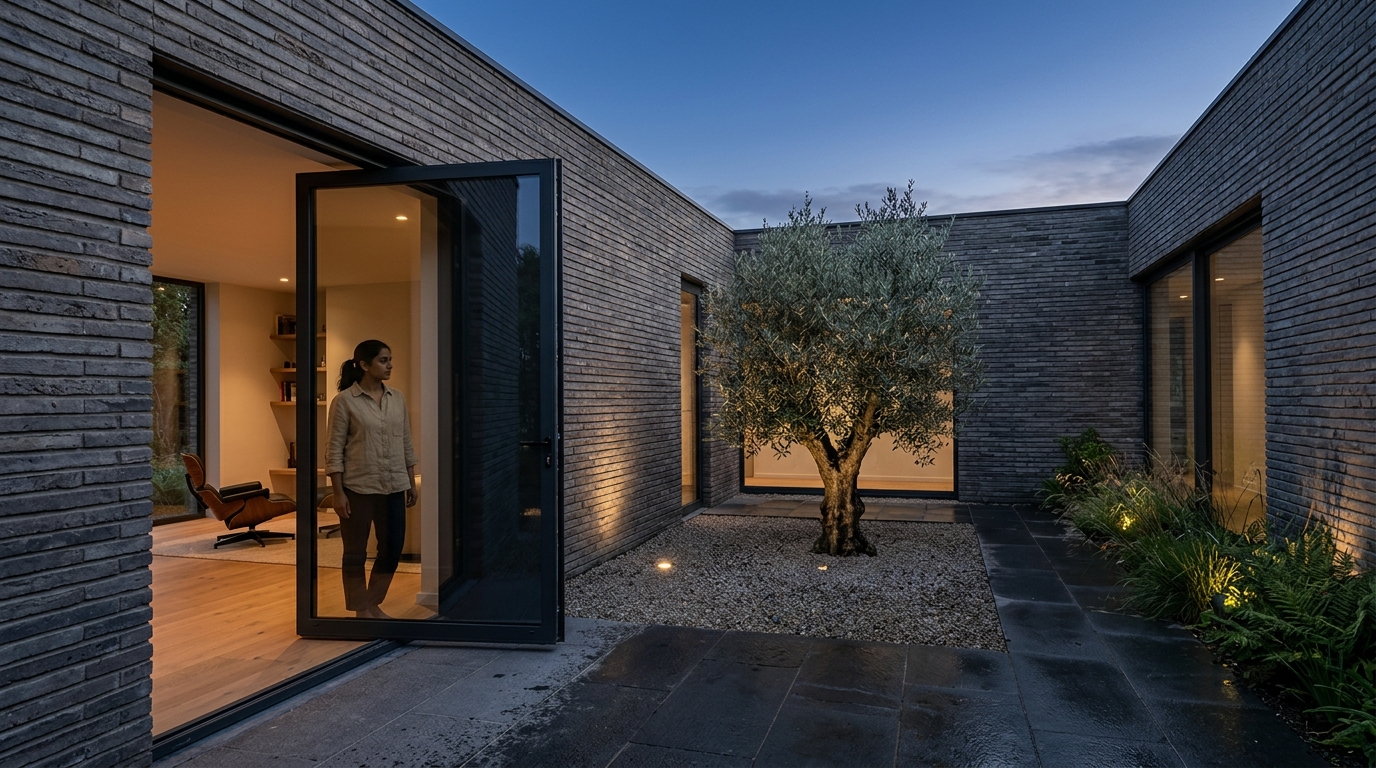
The brick is perhaps the most honest expression of the building arts. Unlike the seamless facade of poured concrete or the reflective void of a glass curtain wall, a brick structure reveals its logic at a glance. It is an architecture composed of thousands of individual decisions, each one a physical manifestation of a mason’s labor and a kiln’s unpredictable heat. To build with brick is to engage with the history of the earth itself, specifically the sedimentary clay that provides the material’s raw, tectonic power. In an era where building components are increasingly digitized and mass-produced, the humble brick remains a vital, haptic link to the fundamental act of making.
In the contemporary residential landscape, where precision often slides into a sterile lack of character, the resurgence of the hand-fired brick represents a return to the palpable. Architects are increasingly looking toward the imperfections of the artisanal module to provide a sense of groundedness. This is not merely a nostalgic gesture: it is a calculated choice to introduce texture and shadow into the domestic sphere. When light grazes a wall of long, thin Roman bricks, the resulting play of highlights and deep recesses creates a rhythmic complexity that smooth surfaces simply cannot replicate. The variation in hue, from sun-scorched ochre to deep, vitrified charcoal, ensures that no two square meters of the facade are ever identical.
The significance of the brick lies primarily in its scale. It is a unit defined by the human hand, making it inherently relatable to the body. This relationship creates a psychological bridge between the inhabitant and the structure. While a monolithic stone wall can feel imposing, even alien, a brick wall is a composite of understandable parts. This modularity allows for a remarkable degree of spatial flexibility. By varying the bond pattern or introducing perforated screens, known as claustra, architects can manipulate the flow of air and light without sacrificing the structural integrity of the home. These screens transform the solid mass into a breathing lung, filtering the harshness of the exterior world into a dappled, interior serenity. The claustra serves as a poetic filter, where the void becomes as structurally significant as the solid material.
Furthermore, the thermal properties of masonry provide a functional justification for its continued use that transcends aesthetic preference. The density of the clay acts as a thermal flywheel, absorbing solar gain during the day and radiating it slowly during the cooler hours of the night. This creates a stable internal climate that feels fundamentally different from a space conditioned solely by mechanical ventilation. The air within a brick-lined room often possesses a distinct stillness, a quality of quietude that is as much about acoustics as it is about temperature. The porous nature of the material absorbs sound, softening the sharp edges of domestic life and contributing to a sense of profound sanctuary. In this environment, the home becomes a thermal and acoustic cocoon, shielded from the frantic pace of the outside world.
The choice of mortar is equally critical in this architectural dialogue, acting as the connective tissue that defines the wall’s character. A deeply recessed joint emphasizes the individual geometry of each brick, creating a grid of shadow that reinforces the modular nature of the work. Conversely, a flush, color-matched mortar can create a monolithic effect that highlights the overall volume of the building rather than its components. Some contemporary practitioners are even experimenting with slumped mortar, where the excess material is allowed to spill over the edges. This creates a rugged, prehistoric aesthetic that blurs the line between the built environment and the natural terrain. It is in these minute details of the joint and the bed that the architect’s true intent is revealed.
Ultimately, the brick is a material of patience. It requires time to lay, time to cure, and time to weather. Unlike the instant gratification of prefabricated panels, a brick home is a slow build. It is an investment in permanence. As the edges of the bricks soften and the colors deepen through decades of exposure to the elements, the house does not simply age: it matures. It gains a character that is earned, not applied. True architectural significance is found in this refusal to decay, opting instead for a graceful evolution that mirrors the landscape. In an era of ephemeral design, the brick remains a steadfast reminder that the most profound architecture is often built one hand-held piece at a time, creating a legacy that is both deeply personal and culturally resonant.