In an architectural landscape often dominated by the ephemeral and the lightweight, a quiet revolution is taking place beneath our feet. For decades, the prevailing residential vernacular has favored the thinness of steel, the fragility of glass, and the modular efficiency of the white box. However, a new generation of architects is looking backward to move forward, rediscovering the primordial power of geological mass. Rammed earth, an ancient method of wall construction that relies on the compression of local soils, is emerging as the definitive material for the contemporary sanctuary. It represents a rejection of the disposable, offering instead a sense of permanence that feels increasingly rare in the digital age.
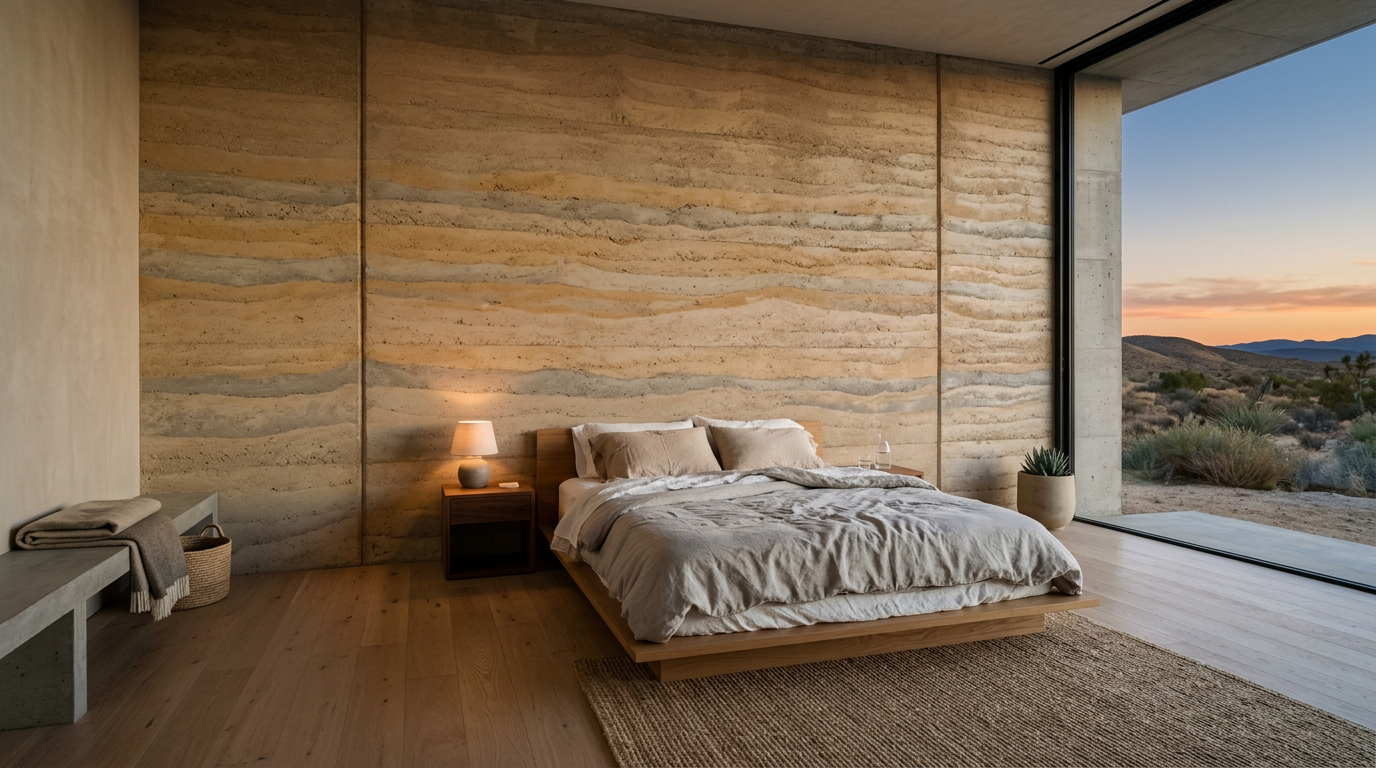
The aesthetic of a rammed earth wall is one of accidental beauty. Because the material is composed of varying layers of sand, gravel, and clay, the resulting surface displays a horizontal striation that mimics the natural sedimentary process of the earth. These lines are not merely decorative: they are the fossilized record of the building’s own creation. Each lift of soil is compressed with pneumatic rammers, creating a monolithic structure that possesses the density of stone but the warmth of terra cotta. In a high-end residential context, this texture provides a necessary counterpoint to the precision of modern cabinetry and the coldness of polished metal. It is a material that demands to be touched, offering a haptic honesty that synthetic alternatives simply cannot replicate.
Beyond its visual gravity, the architectural significance of rammed earth lies in its extraordinary relationship with the environment. Unlike traditional timber-frame or light-gauge steel construction, which relies on mechanical systems to regulate temperature, rammed earth functions as a thermal flywheel. The sheer density of the walls allows them to absorb solar heat during the day and release it slowly into the interior as the outside temperature drops. This creates a living environment that feels biologically aligned with the passage of time. The interior climate does not fluctuate with the frantic pace of a thermostat: it moves with the slow, deliberate breath of the ground itself. This thermal stability is matched by an acoustic stillness that is almost impossible to achieve with modern stick-built homes. To stand inside a rammed earth room is to experience a profound sense of enclosure, where the noise of the outside world is swallowed by the mass of the walls.
The dialogue between a rammed earth structure and its site is inherently honest. By utilizing soil sourced directly from the excavation or from local quarries, the architect ensures that the home’s color palette is a literal extension of the landscape. Whether it is the deep ochres of the high desert or the muted greys of a coastal bluff, the house becomes a chromatic reflection of its coordinates. This is not a building placed upon the land, but a building born from it. This connection fosters a unique psychological experience for the inhabitant: a feeling of being anchored rather than merely sheltered. In an era of globalized aesthetics, where a luxury home in one city can look identical to one three thousand miles away, rammed earth provides an unshakeable sense of place.
The craft of building with earth also requires a different kind of architectural discipline. There is no room for the structural concealment common in modern drywall construction. The walls are the structure, the finish, and the insulation all at once. This material singularism requires a meticulous level of planning: electrical conduits and plumbing must be cast into the walls with absolute precision, as there is no cavity to hide mistakes. The result is a home that possesses a rare integrity, where the logic of the build is visible in every corner. It is a return to the idea of the house as a cultural artifact: a structure built to endure for centuries rather than decades. By embracing the weight of the ground, we find a way to build that is both ancient and radically new.